The Walvis Bay Corridor Group (WBCG) was established in 2000, to drive business development initiatives that increase cargo volumes through the Port of Walvis Bay and the Port of Lüderitz, and along their associated corridors.

Welcome to the Walvis Bay Corridor Group

The Walvis Bay Corridor Group (WBCG) was established in 2000, to drive business development initiatives that increase cargo volumes through the Port of Walvis Bay and the Port of Lüderitz, and along their associated corridors. 

In parallel, the WBCG facilitates coordinated corridor development and infrastructure enhancement to ensure efficient, seamless regional trade.

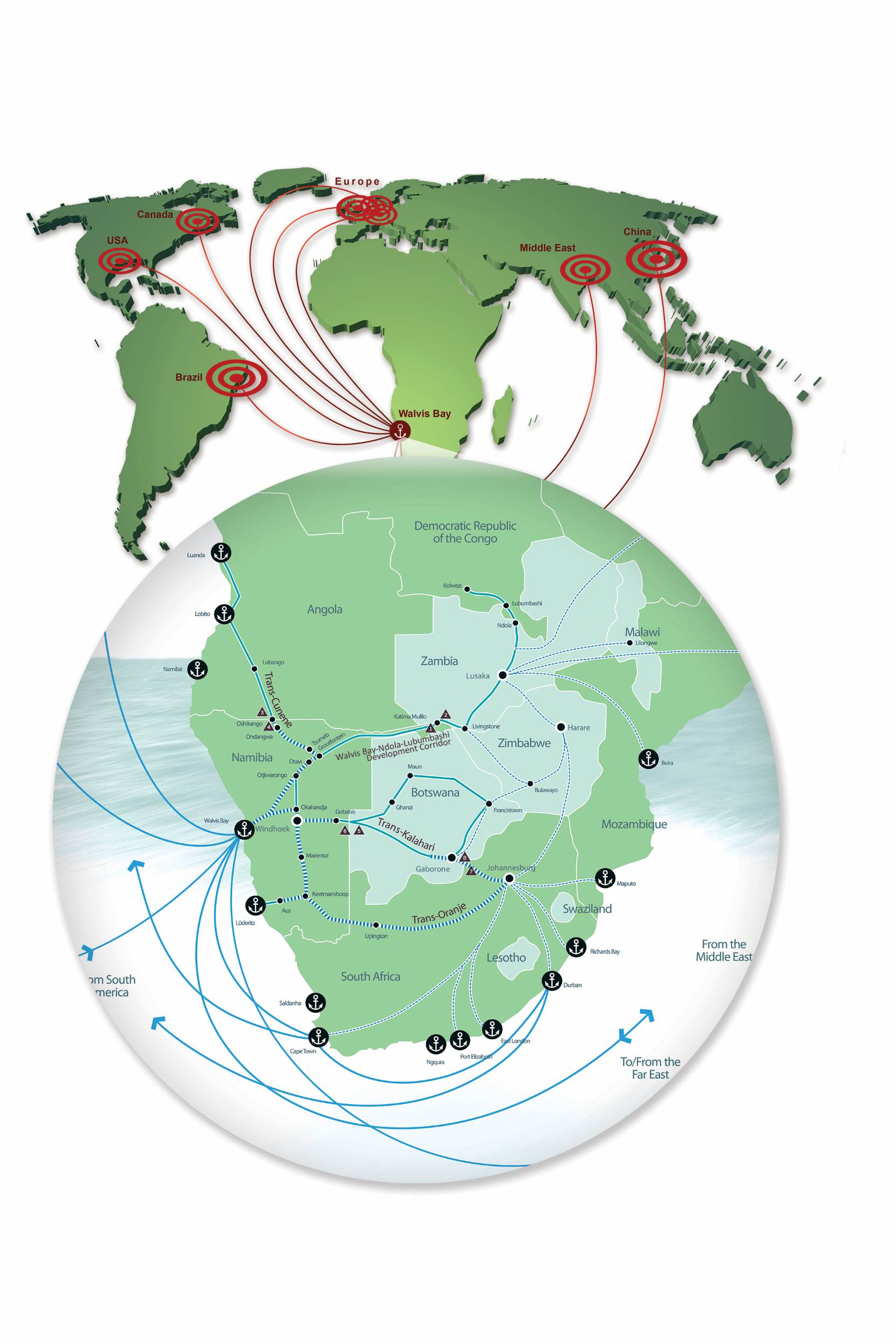
The Walvis Bay Corridors, consist of an integrated system of well maintained tarred roads and rail networks – accommodating all modes of transport – from the Port of Walvis Bay via the Trans Kalahari Corridor, Walvis Bay-Ndola-Lubumbashi Development Corridor, Trans-Cunene Corridor; and from the Port of Lüderitz, via the Trans-Oranje Corridor providing landlocked SADC countries access to global. markets.

2000–2004: Establishing the Corridor

Institutional Foundation

2005–2009: Trade Horizons & Wellness Programs

Corridor Growth • Roadside Wellness Development

2010–2014: Partners & Trade Innovation

Port & Corridor Milestones

2020–2025: Health, Trade Diversification, and Inclusive Growth

Wellness Services & Public Health leadership

The Trans Kalahari Corridor links the Port of Walvis Bay to Gaborone and Gauteng in South Africa. From there, this Corridor links with the Maputo Corridor on the east coast of southern Africa. The Walvis Bay-Ndola-Lubumbashi Development Corridor accesses the landlocked countries of the Democratic Republic of Congo, Zambia and Zimbabwe. The Trans-Cunene Corridor extends through northern Namibia into southern Angola, and the Trans-Oranje Corridor links the Port of Lüderitz with the Northern Cape Province of South Africa.

The Walvis Bay Corridor Group’s main organisational strength is its unique public-private partnership (PPP) set-up of transport and logistics stakeholders from both the public and private sector.

The partnership allows for the pooling of resources, expertise and authorities from both the regulators and the operators, who together form an integrated transport and logistics service for potential customers.

Due to the Group’s constitution as a PPP, it is able to lean on the public sector for advice and action on issues such as customs, transport regulation and infrastructure development, while the private sector can focus on business development such as marketing and making practical operational proposals and logistics solutions. Both arms provide input into developing human resources, the institutions themselves and the associated infrastructure.


The Walvis Bay Corridor Group has branch offices that facilitates cross border business development in Lusaka Zambia, Johannesburg South Africa, and Lubumbashi, DRC. It further extends its footprint by developing transport forums, based on the PPP principle across the borders of Namibia with neighbouring countries. The first transport forum that was set up was the Trans Kalahari Corridor Management Committee through a Memorandum of Understanding between Botswana, Namibia and South Africa in 2003. This management committee established the Trans Kalahari Corridor Secretariat (TKCS).

The WBCG has additionally led the process in developing a transport forum along the Walvis Bay-Ndola-Lumbumbashi Corridor between Namibia and Zambia in 2005 which has evolved into the Walvis Bay-Ndola-Lubumbashi Corridor Development Committee between the Democratic Republic of the Congo, Namibia and Zambia in 2010.